
A driveway can be a convenient home court for casual games and practice. But not every net works well on a driveway. You need one that balances portability, stability, storage, and reliable play.
This guide explains what makes a driveway net suitable and helps you choose an A11N net that fits your space.
Why Driveway Play Needs the Right Net
Driveway setups are temporary and shared spaces. A net may need to be moved, stored, or adjusted for cars, bikes, or household use. A net that is too heavy, flimsy, or hard to set up will reduce your play frequency.
Good driveway nets provide:
- Quick and easy setup
- Stability during play
- Portability for storage
- Reliable net tension
- Suitability for concrete or asphalt surfaces
Key Factors for Driveway Nets

Easy Setup and Breakdown
A driveway net should be simple to assemble and take down. This ensures you can play spontaneously without extra effort.
Practical Portability
Look for a net that one person can move easily, with wheels or a carrying system if possible. Portability allows flexible positioning and easy storage.
Stable Frame on Hard Surfaces
Driveways are often concrete or asphalt. The net must stay upright and tensioned during play. A stable frame enhances the overall game experience.
Simple Storage
Consider where the net will live when not in use. Driveways often double as parking or storage, so compact folding and light weight are essential.
Reliable Net Tension
Even for casual play, consistent net height and tension improve rallies and prevent sagging during repeated use.
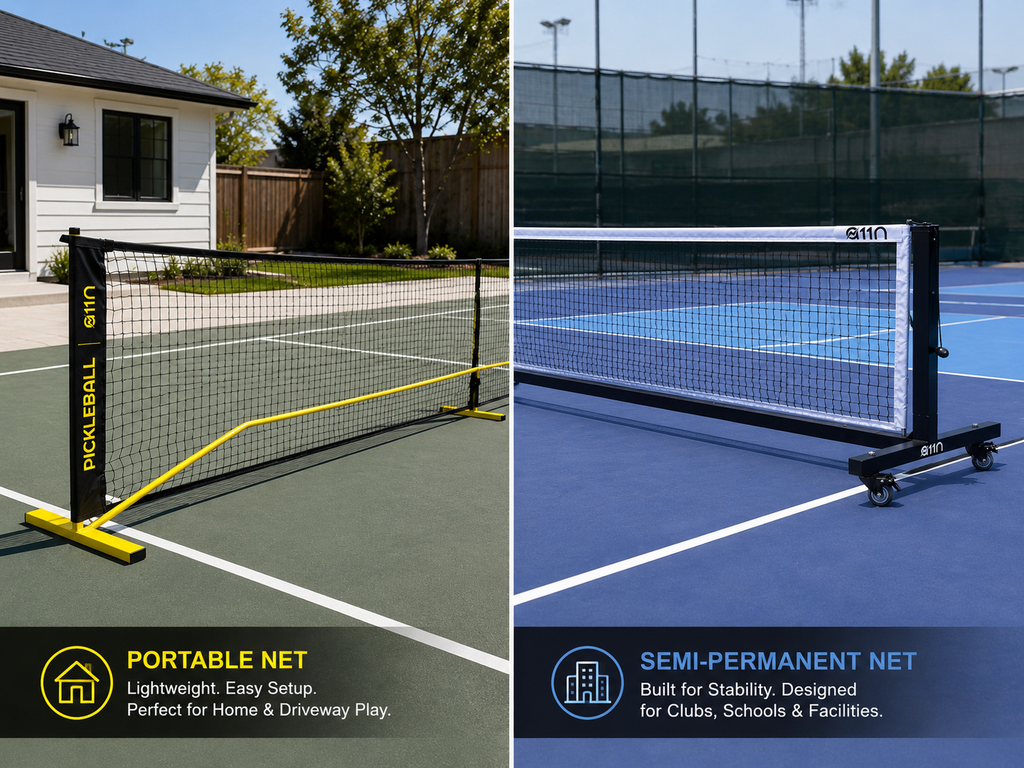
Portable vs Semi-Permanent Options
| Net Type | Best For | Driveway Fit |
|---|---|---|
| Lightweight Portable | Casual home play | Easy to move and store |
| Sturdier Portable | Regular home use | Balanced stability and portability |
| Wheeled Net System | Shared spaces | Simplifies movement and repeated setup |
| Semi-Permanent | Long-term home court | Stable, less flexible |
| In-Ground | Permanent court | Usually not suitable for shared driveway |
For most driveway users, portable or sturdier portable nets are ideal. Semi-permanent options are for more fixed setups.
Surface Considerations
- Concrete: Firm and level, stable for lightweight or portable nets.
- Asphalt: May be slightly uneven; stability is more critical.
- Sloped Driveways: Minor slope can work, but net may need extra care for stability.
- Shared Driveways: Prioritize portability for multi-use areas.
Quick Buying Checklist
- Will the net be moved after each game? → Portability matters.
- Can one person set it up? → Ease of setup.
- Where will it be stored? → Storage convenience.
- Is the driveway flat, concrete, asphalt, or sloped? → Surface stability.
- How often will you play? → Frequency affects frame and tension needs.
- Casual or regular use? → More frequent play benefits sturdier nets.

Which A11N Net Fits Driveway Play?
- Casual play: A11N Lite 22ft Portable Net – easy setup and storage.
- Regular home use: A11N Core 22ft Portable Net – stable, dependable, practical.
- Shared driveway or community use: A11N Pro 22ft – wheeled, sturdy, supports repeated use.
For detailed comparison, see our A11N Pickleball Net Comparison Page.
Common Driveway Mistakes
- Choosing a net based only on price
- Ignoring setup frequency or storage space
- Overlooking surface conditions
- Treating a temporary driveway like a permanent court
Final Recommendation
The best driveway pickleball net is portable, stable, easy to store, and fits your driveway layout. Lightweight nets work for casual play; sturdier portable nets suit regular use. Semi-permanent setups are only for less flexible, long-term installations.
Leave a comment