
Choosing between a portable and semi-permanent pickleball net usually comes down to one question:
How flexible does your setup need to be?
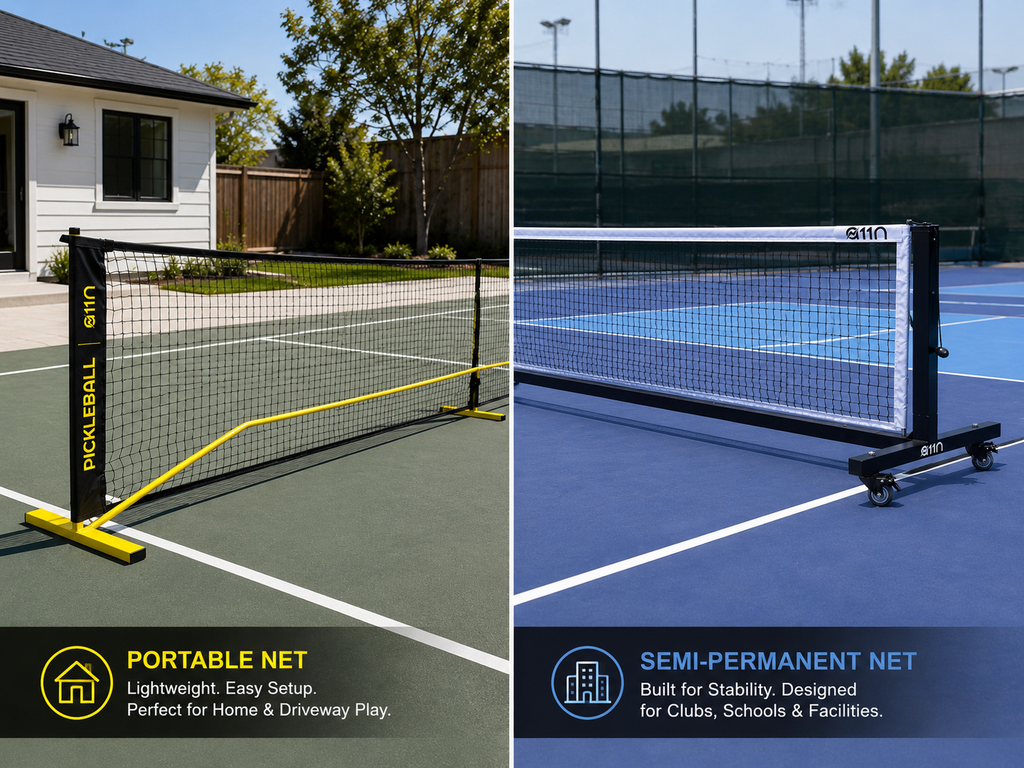
A portable net gives you easier movement, storage, and setup flexibility. A semi-permanent net gives you a more substantial playing experience and better stability for spaces where the net can stay in place more often.
Both options can work well, but they are built for different needs. This guide compares portable vs. semi-permanent pickleball nets so you can choose the right setup for your home, club, school, community center, or facility.
What Is a Portable Pickleball Net?
A portable pickleball net is designed for flexible setup. It can usually be assembled, moved, taken down, or stored when the court is not in use.
Portable nets are common for driveways, backyards, temporary courts, community spaces, gyms, and shared-use areas. They are especially useful when the playing space has more than one purpose.
A portable net is often the right choice if you need to:
- Move the net after playing
- Store the net in a garage, shed, or equipment room
- Use the same space for other activities
- Set up pickleball in different locations
- Keep setup simple for home or recreational play
The main benefit is flexibility. The tradeoff is that some portable nets may feel lighter or less stable than more fixed systems, depending on the frame, base, and net tension.
What Is a Semi-Permanent Pickleball Net?
A semi-permanent pickleball net is designed for a more fixed court setup. It is not usually as permanent as an in-ground net system, but it is meant to stay in place more often than a basic portable net.
Semi-permanent nets are a strong fit for dedicated home courts, clubs, schools, community centers, and facilities that want a more stable setup without committing to a fully permanent installation.
A semi-permanent net may be the right choice if you need:
- A more court-ready feel
- Better stability during repeated play
- A net that can stay in place for longer periods
- A more substantial frame
- A setup that supports organized or regular use
The main benefit is stability and consistency. The tradeoff is that it is usually less flexible than a portable net and may require more space, planning, or effort to move.
Quick Comparison: Portable vs. Semi-Permanent Nets
| Factor | Portable Net | Semi-Permanent Net |
|---|---|---|
| Best For | Driveways, backyards, temporary courts, shared spaces | Dedicated courts, clubs, schools, facilities, repeated use |
| Setup Flexibility | High | Medium |
| Stability | Varies by frame and base | Usually stronger |
| Storage | Easier to store | Less storage-friendly |
| Mobility | Easier to move | Less convenient to move |
| Court Feel | Practical and flexible | More substantial and court-ready |
| Best User | Home users, casual players, multi-use spaces | Frequent players, clubs, schools, facilities |
If you need flexibility, start with portable. If you need consistency and the net can stay in place, semi-permanent may be the better direction.
When a Portable Pickleball Net Makes More Sense
A portable net is usually the better choice when the court space is temporary or shared.
For example, if you are setting up on a driveway, you may need to move the net when the space is used for parking. If you are using a school gym or community center, the court may need to be cleared for other programs. If you play in a backyard or multi-use outdoor space, storage may matter just as much as play quality.
A portable net is also a good starting point for players who are still deciding how often they will play. It gives you a way to create a usable court without committing to a more fixed setup.
Choose a portable net if your top priorities are:
- Easy setup
- Easy storage
- Flexible location
- Lower commitment
- Multi-use space compatibility
- Occasional or casual play
For many home users, a portable net is the most practical option.
When a Semi-Permanent Pickleball Net Makes More Sense
A semi-permanent net makes more sense when the playing space is more dedicated.
If you have a home court area, club court, school court, or facility space where pickleball is played regularly, stability becomes more important. The more often people play, the more the setup needs to feel dependable.
Semi-permanent nets are useful when you want the court to feel more consistent and ready for repeated use. They are also better suited for users who care more about playing experience than daily storage.
Choose a semi-permanent net if your top priorities are:
- Stronger stability
- More consistent net tension
- A more court-ready setup
- Regular or repeated use
- Organized play
- A dedicated or semi-dedicated court space
For clubs, schools, and facilities, semi-permanent options often provide a better long-term setup than basic portable nets.
Key Questions Before You Choose
Before choosing between portable and semi-permanent, ask these questions.
1. Will the net stay up most of the time?
If the net needs to be moved after every game, choose portable. If it can stay in place for days or longer, semi-permanent may be worth considering.
2. Is the space shared?
Shared spaces usually need portable nets. Dedicated courts can support semi-permanent setups more easily.
3. How often will people play?
Occasional play usually does not require a heavier setup. Regular play benefits from more stable construction and more consistent tension.
4. Who will move or set up the net?
If one person needs to manage the net alone, portability matters. If staff, coaches, or facility managers handle setup, a more substantial system may be practical.
5. What matters more: convenience or court feel?
Portable nets prioritize convenience. Semi-permanent nets prioritize a more dependable playing experience.
Which Setup Is Better for Different Use Cases?
Driveways
Portable nets are usually the better choice for driveway play. Most driveways are shared with cars, bikes, storage, and household activity. A portable net makes it easier to move the setup when needed.
Backyards
For casual backyard play, portable nets are usually enough. If the backyard has a dedicated hard court or court-like surface, a semi-permanent option may be worth considering.
Schools and Community Centers
Both options can work. Portable nets are better for gyms and shared recreation spaces. Semi-permanent nets are better when the court area is used regularly for pickleball programs.
Clubs and Facilities
Semi-permanent nets are often a stronger fit for clubs and facilities because they support repeated use and a more organized playing environment. Portable nets can still be useful for events, extra courts, or flexible programming.
Dedicated Home Courts
If you have a dedicated home court, semi-permanent may offer a better long-term playing experience. If the court is still shared with other activities, portable may be more practical.
Which A11N Net Direction Fits Your Setup?
A11N offers pickleball net options for different playing environments, from casual home use to more stable repeated-use setups.
If you need simple movement and storage, a portable net is usually the right place to start. This is especially true for driveways, backyards, and temporary play spaces.
If you want something more substantial for regular home play or shared-use environments, look for a sturdier portable option that balances mobility with stability.
If your court can stay set up more often and you want a stronger playing feel, a semi-permanent net may be the better direction.
For a side-by-side view of A11N net options, compare setup type, portability, stability, materials, and best-use scenarios on the A11N net comparison page.
Final Recommendation
Choose a portable pickleball net if your space needs flexibility. It is the better fit for driveways, backyards, temporary courts, and shared spaces where the net needs to move or store easily.
Choose a semi-permanent pickleball net if your space is more dedicated and your top priority is stability. It is a better fit for regular play, organized use, clubs, schools, facilities, and home courts where the net can stay in place more often.
The right net is not just about size or price. It is about how the setup will actually be used.
When the net fits the space, setup becomes easier, play feels more consistent, and the court becomes more dependable.
FAQ
Is a portable pickleball net good enough?
Yes, a portable pickleball net is good enough for many home users, driveway setups, backyard play, and temporary courts. For more regular or organized play, choose a sturdier portable net or consider a semi-permanent option.
What is the main difference between portable and semi-permanent pickleball nets?
The main difference is flexibility versus stability. Portable nets are easier to move and store. Semi-permanent nets are more stable and better suited for repeated use in a dedicated space.
Which net is better for driveway pickleball?
A portable net is usually better for driveway pickleball because most driveways are shared spaces. You can move or store the net when the driveway is needed for parking or other household use.
Which net is better for clubs or facilities?
Semi-permanent nets are often better for clubs and facilities because they provide a more stable setup for repeated play. Portable nets can still be useful for flexible courts or temporary programming.
Should I buy a portable net or a semi-permanent net for a home court?
If your home court space is shared, choose portable. If it is dedicated mostly to pickleball and the net can stay in place, semi-permanent may give you a better playing experience.
Leave a comment